We are counting down to our ISS crew contact which will take place during the first week in December. Steps in our final preparations are taking place on almost a daily basis now. Several of us visited Hudson Memorial School yesterday to work out final plans for setting up our ground stations and the supporting Audio Visual and Data Systems.
We are also working closely with the ARISS team to finalize our contact details including prioritizing candidate ISS passes, finalizing student questions, etc.
We are posting frequent updates in the Youth Forum on the Nashua Area Radio Society website and I thought that some of our readers here might be interested in seeing these posts too. You can follow the link above to check for what will likely be new updates on our progress every few days.
Our planned ISS Crew Contact is almost here! It will take place sometime during the first week of December (December 3rd – 8th) at the Hudson Memorial School (HMS) here in Hudson, NH. I am planning a series of articles here on our blog to explain the process for preparing our ground station(s) and making contact.
The Beginning
Dan Pooler, AC1EN who is a teacher at HMS began this process almost a year ago by reaching out to the Nashua Area Radio Society. Dan wanted to do an ISS Crew Contact at his school and asked if we would help him with the Amateur Radio elements.
We decided early on that we wanted a Direct contact (one which uses an on-site Amateur Radio Ground Station).
Transceiver with 50–100 W output, 1 kHz tuning steps, and 21 memories capable of storing split frequencies
Low-loss coax (such as 9913 or LMR-400)
Mast mounted receive pre-amplifier
14-element yagi antenna with switchable circular polarity
Antenna rotators for azimuth (0–360°) and elevation (0–180°), with an interface for computer control
Computer running tracking software for antenna control (including flip mode operation)
The ARISS approach is to use a series of “secret” uplink frequencies which are determined and provided only to the contact operators before each contact. Doppler correction is not required on the 2m band where the crew contacts take place.
14-element yagi antenna with switchable circular polarity
Satellite Station 2.0 Antenna Details
Our 2.0 Station has an 8-element yagi with fixed polarity. This requirement turned out to have a much more significant impact on the design of the Primary Ground Station than just changing the antenna and ultimately led to the construction of our Portable Satellite Station 3.0. More on this in a minute…
The Backup Station
The backup station requirements are as follows:
Transceiver with 50–100 W output, 1 kHz tuning steps, and 21 memories capable of storing split frequencies
Power amplifier with 100–200W output (optional)
Low-loss coax
Mast mounted receive pre-amplifier
Omnidirectional antenna, either vertical (preferred) or eggbeater style
An uninterruptible power source (UPS or battery)
Our Approach
After consulting with the ARISS folks and some thought, we decided to use the then-current Satellite Station 2.0 as the Backup Station and build a new Satellite Station 3.0 for use as the Primary Station. This approach also involved installing a larger rotator to accommodate the larger antenna and a heavier fiberglass cross-boom. The 3.0 station would also receive a more capable antenna for the 70 cm band and add a 23 cm antenna for a third band.
The plan included upgrading the 2.0 Station Antennas to include switchable polarity and the addition of a 200W power amplifier for 2 m to compensate for the reduced gain of the smaller 8-element yagi in the 2.0 station.
Building The Primary Station
Satellite Station 3.0 Antenna System
The construction and testing of the 3.0 Station are well covered in articles on our Blog, so I’ll just share a little information about the final result. The new antenna system used the same ground-based roof tower arrangement that worked well for the 2.0 station. The larger 3.0 antennas are center mounted on a fiberglass cross boom to prevent the Boom from affecting the antenna patterns. We’ve also added a 23 cm loop yagi for a third band. The 3.0 antenna system also uses a more powerful Azimuth-Elevation Rotator from Alfa-Spid.
2m Yagi Switchable Polarity feed point
The new 2 m and 70 cm antennas use relays at their feed point to enable remote switching of the antenna’s polarity between Left-Hand and Right-Hand circular polarity.
Satellite 3.0 Station Radio and Controls
The upgraded 3.0 ground station adds a control console for switching the polarity of the antennas and a custom-built PPT Router Device to manage PTT sequencing of the radio and the pre-amplifiers at the antennas.
Computer Control via MacDoppler
We continue to use the excellent MacDoppler software to control tracking and Doppler correction in the 3.0 Station.
Building The Backup Station
Upgraded 2.0 Antennas
The upgrades to the 2.0 Antenna System involved the installation of Polarity Switching relays in the feed points of the 2.0 antennas. This upgrade was a fairly straightforward one.
Backup Station Radio and Controls Test
The ground station side was more involved as we needed to build a complete second station. I was able to purchase an Icom IC-910H radio used in good condition for this purpose. The rest of the station components were similar to the Primary Station.
Backup Station Test at the Fall Tech Class
We tested the Backup Station at our Fall Technician License Class, and it worked great! several of our class students used the station to make their first satellite contacts.
I am working on adding a 2 m amplifier and improving the PTT sequencing system on the Backup Station, and I plan to post more about these upgrades here in the near future.
Audio System for Our Contact
Mixing Board at HMS
Our contact will take place in the auditorium at HMS. The room has a high-quality sound system and a mixing board for audio.
Audio System for ISS Contact
Dave, K1DLM, is part of our ISS Crew Contact Team and has quite a bit of pro-level audio experience. He has put together the following plan for our Audio System. His design allows us to smoothly transfer audio to and from the Primary or the Back Stations. We are also planning to record a video and Livestream video to the N1FD Facebook page during our contact, and his design also supports these elements.
Data System for ISS Contact
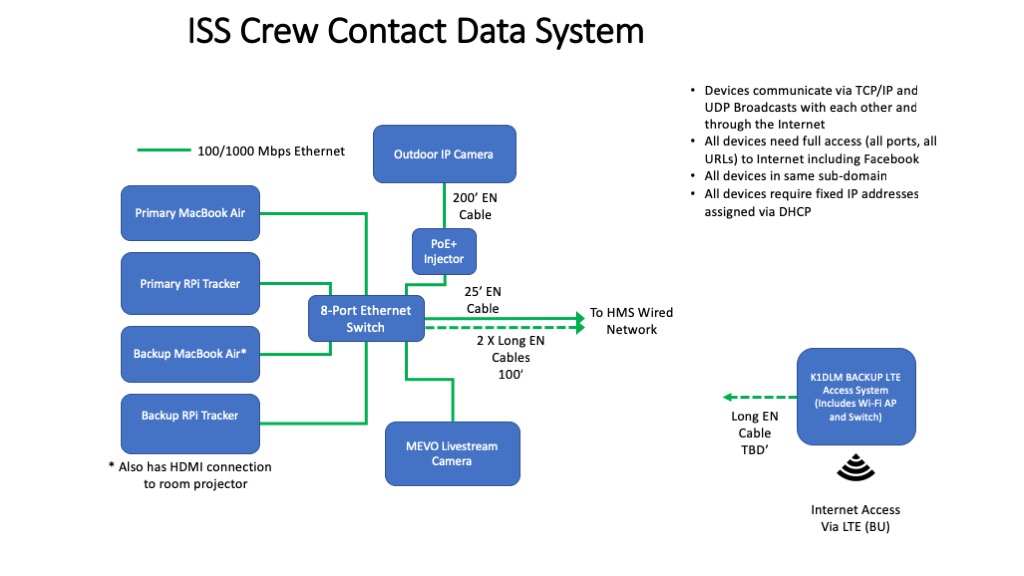
The final element in our plan is the Data System. The network at HMS is very tightly controlled from a security point of view, making it difficult to use for contact critical functions like access to up-to-date Keplerian Elements for our straightforward. Dave has an LTE-based Internet Access System that we have used in the past and elected to use to support our stations. We are planning to use the HMS network to transport the Livestream video from our contact. We’ll be using a Mevo Internet Camera for this purpose.
A Million Details…
As you can probably imagine, many details go into making a project like this possible. Here’s a rough timeline of some of the major remaining steps from a Ground Station point of view:
Assemble both stations at our QTH with the 2m amplifier and the final 215′ control cables and feed lines – In progress and should be complete in a few days.
Full Station Test – add the Audio and Data System components and test the full station at our QTH – Within a week.
Configure and Test Data Network Access – for Live Streaming Video and the computers.
Set up Ground Station at HMS and perform Dry Run Test – Complete by December 1st.
Dan and the HMS faculty team are also very busy finalizing the student’s questions and handling press-related activities.
We hope our readers will join us via the Livestream video for our contact. We’ll post more on this as we get closer!
We have established launch windows and begun final launch preparations for our High-Altitude Balloon 4 (HAB-4) launch. We’ve made some modifications to our HAB platform to improve its cold temperature performance and we’ve determined the Balloon and flight path parameters for the upcoming flight. HAB-4 will carry an APRS transmitter and can be tracked using aprs.fi. You can read more about HAB-4 flight preparations via the link that follows.
You can see more about what we are planning via the link above. Activities will include multiple GOTA Stations, a Kit Build, a Fox Hunt, Morse Code, and other hands-on activities. We will also be operating a Special Event Station as N1T.
The Nashua Area Radio Society put together a successful Amateur Radio Youth Exposition at the New England Amateur Radio Convention at Boxboro this year. Our exposition features over ten displays with hands-on activities…
Anita AB1QB and I are continuing to work along with the Nashua Area Radio Society to encourage young people to become licensed and join the Amateur Radio Service.
Anita and I have been working to grow the Amateur Radio Service through our work at the Nashua Area Radio Society. The Nashua Area Radio Society is a 501c(3) public charity whose mission is to:
Encourage and help people to become licensed and active in the Amateur Radio Service
Spark Interest among Young People in STEM Education and Careers through Ham Radio
Provide training and mentoring to enable our members to improve their technical and operating skills and to be prepared to assist in times of emergency
Sponsor on-air operating activities so that our members may practice and fully develop their operating skills and have fun with Ham Radio!
Students and Teachers Ready To Launch Their High-Altitude Balloon
The Nashua Area Radio Society has created many programs designed to provide STEM learning experiences and training through Amateur Radio. Some of these include:
Emergency Communications Training through our Field Day and other activities
Supporting Local Schools with ARISS Crew Contacts and other Amateur Radio activities
To carry out our mission, we have formed close relationships with several schools. This helps us develop and deliver effective, high-quality programs that bring learning through Amateur Radio to young people. You can read more about what we’re doing via the link at the top of the page.
We provide many of these services either free of charge or at a very modest cost. We count on the generosity of our members, friends, and the Amateur Radio community to raise funds to support our work.
We hope that our readers will consider supporting our work at the Nashua Area Radio Society by using Amazon Smile and designating us as your favorite charity and/or by making a donation to our current fundraising campaign (click on the badge below).
On behalf of the many young people and others that we help, thank you very much for your interest and support. We will continue to work hard to provide learning opportunities for young people through Amateur Radio and to continue to make the Amateur Radio Service the best it can be to benefit everyone.
Quite a few Nashua Area Radio Society members have been working on a display to get young people and potential new Hams interested in Amateur Radio. Our display will be part of the New England Amateur Radio Convention in Boxboro, MA on September 8th and 9th. We are also planning a similar display for NEAR-Fest at Deerfield Fairgrounds, NH later in the fall. You can see more about our planned display and the associated hands-on activities via the following link.
I want to share some information about an Amateur Radio event that we will be doing at the Boxboro, MA Ham Radio Convention in September. Our display and hands-on activities provide an introduction to Amateur Radio for young people and include information and a chance to try Amateur Radio activities such as:
You can read more about our plans for the event via the link above.
Morse Trainer Kit
We’ve been working with Steve Elliot, K1EL to develop an inexpensive kit building project to include as part of our displays. We will be including a new kit building activity in as part of our display. Builders can purchase the Morse Trainer Kit shown above for $20 and build it at the show. We will provide soldering equipment and kit building mentors to help builders complete their kit. The package includes batteries and a printed manual. We will have these kits available for walk-up purchase at the show on both Saturday and Sunday.
I am also planning to provide forum presentation on the following topics on Saturday at Boxboro:
Creating Successful Youth Outreach Projects
Portable Satellite Station Design, Operation, and Planning for an upcoming ISS Crew Contact
STEM Learning for Young People via High Altitude Balloons Carrying Amateur Radio
I hope to see folks who follow our Blog at the New England at the Boxboro Convention. If you can make it, stop by our display or visit us in the forums and say “hello”.
We are planning the third launch of our High-Altitude Balloon (HAB-3) this Sunday, June 3rd between 10 am and 11 am ET. We will be launching locally from the Hollis-Brookline HS here in Hollis, NH. Checkout the link below to learn more about our HAB projects and how to track our HAB from anywhere in the world while it is in flight. You can also see live stream video froun our launch and recovery via the N1FD Facebook Page.
The video above is a capture of the school’s contact. It was very easy to receive the ISS downlink on our portable backup ground station. I heard the downlink a few seconds before the ISS came up on the horizon and the audio was solid for the duration of the contact. We can only hear the astronaut’s side of the contact as we cannot receive the school’s uplink from Raleigh, NC. The ISS pass began here in New Hampshire part way through the school’s session so we did not hear the first few questions.
Update on Portable ISS/Sat Station 3.0
Portable ISS/Sat Station 3.0 Antenna System
Work on our upgraded primary Portable 3.0 Station which includes a larger antenna system using switchable circular polarity is progressing well. The portable tower, upgraded rotator system, and the new, larger 2m and 70cm circularly polarized antennas are complete. We are just waiting for a few additional components to arrive here and the upgraded portable ground station should be ready for its first test at our Technician License Class later this month.
More on Today’s ISS Crew Contact
You can see a live stream of the ISS Contact from the school above. There is a great deal of planning which goes into an ISS Crew Contact such as this. We are working closely with Hudson Memorial School on their project and their school is also beginning a High-Altitude Balloon Project with us in a few weeks.
The ISS Crew Contact today was exciting to listen too and we are looking forward to being able to share this experience with Hudson Memorial School in the near future.
We got together with the students who did our HAB-2 launch this week to analyze the data from the flight and to preview some of the videos that HAB-2 captured during its flight. You can read more about what we learned from the flight data on the Nashua Area Radio Society website via the link above